Showing posts with label Gabriel Howells. Show all posts

Howells Placeline

So I think this is the last post of this series, because as you can see, these are getting fainter in knowledge as I go back in time. I have thoughts as to what I might do next, but for now I think I'll go back to one post a week for a bit until I work up some new posts. I hope everyone's enjoyed these, even if just a little.

The Howells line, as I said a few weeks ago, is one I believe is of Huguenot origin, but as of yet, the Howells and Gabriels online have not yet managed to get far enough back to prove or disprove this link.

As always, Bold are Birth, Marriage, and Death locations, and Italics are other locations.

1. Eliza Anne aka Bessie Howells

A. New Westminster, BC, Canada. New Westminster is basically a suburb of Vancouver, and it was here where Bessie lived until her death at the age of 94. I'm so lucky I got to know her for as long as I got--ten years. I still miss my Nain.

B. Vancouver, BC, Canada. I'm not sure exactly when she moved to Vancouver, but it was here she met her husband, and here she made her life with him. All four of their children were born in Vancouver, and she lived here for more than half of her life.

C. Winnipeg, Manitoba, Canada. When the Howell family first came to Canada, they lived for a time with Bessie's uncle Louis, who had a farm in Saskatchewan, but soon moved to Winnipeg, where they lived for several years until the family slowly migrated one by one east because of the milder winters available in Vancouver.

D. Pontypridd, Wales. Pronounced Pant-ee-prith. This is where the family lived before Bessie's father finally decided it would be better for the family to move to Canada. Bessie's two younger siblings were born here.

E. Penrhiwceiber, Wales. Pronounced Pen-ruh-ky-ber. This is a small mining town in southern Wales where the family was living when Bessie was born.

2. Gabriel Howells

A. Vancouver, BC, Canada. In his later years, Gabriel and his wife Selina moved to Vancouver to be close to their children. They celebrated their 50th anniversary here, and lived here together until her death in 1933, and his in 1934, ten years after that anniversary.

B. Winnipeg, Manitoba, BC. After a short time in Canada, remembering why he didn't like farming, Gabriel moved the family to Winnipeg, where Gabriel was able to use his masonry skills to make a good living.

C. Pontypridd, Wales. Gabriel was working with the mines here, using his masonry to help shore up the mines before he realized that not actively doing the mining was no less unhealthy, and thus he decided it was time to find a less unhealthy job. He soon decided that it would be better to move to Canada and start a whole new life.

D. Penrhiwceiber, Wales. This is where the family moved to for a time before moving to Pontypridd, working with the mines to help with masonry there.

E. Dolgelly, Wales. Pronounced Dol-geh-lay. Also spelled Dolgellu, depending on when and where the record is written up. This is where the family lived while Gabriel was young, and it was here he met and married his wife, Selina. They started their family here, losing two children in an influenza epidemic and having four more children before moving south so that Gabriel could make money with his masonry skills, leaving the family farm to his younger brother to run.

F. Tywyn, Wales. This is the place I have always had as my great-great grandfather's birthplace. It is very close to Dolgelly, so it's possible he never lived here, but was just born her for some reason, as the ancestors I have listed for him only have Dolgelly as their place of residence from birth to death.

3. Howell Gabriel

A. Dolgelly, Wales.  This is the only location I have for Howell or the ancestors I have for him, I believe they lived and died here for many generations.

4. Gabriel Howel

A. Dolgelly, Wales. See Howel above. 

5. Howell Gabral

A. Dolgelly, Wales. See Howel above. 

6. Howel Gabriel

A. Dolgelly, Wales. See Howel above. If I am right, I believe this is the place my Huguenot ancestor settled after leaving France, but as of yet, I have no proof of that.

And that's all the locations for this branch of the family, which gives me another 7 locations.

It's been very interesting looking into where my family lived, and I highly recommend going through your family's locations from time to time. It definitely helps you find things you may have missed before, or correct issues in your tree.

52 Ancestors - Favorite Photo - Gabriel & Selina's 50th Anniversary


This photo is of Gabriel and Selina Howells' 50th Anniversary, they were my great great grandparents. The event was held in Vancouver, BC. They're the lovely elder couple in the center of the shot, with their children behind them and their grandchildren around them. The little girl in the front left is my grandmother, Merle, who would have been about eight or so at the time. Her older sisters are the two in the front right, and her little brother is the one on Selina's lap, I believe. Her parents are in the back right. He's the last in the back, and she's the second woman from the right. Most of their family lived in the area, but one branch did drive all the way up from California to attend.

Gabriel and Selina were married in Northern Wales in 1874. He was the eldest of his family, and was meant to be the one to inherit his family farm, but he wanted to go into masonry, and so after a horrible influenza outbreak where they lost their first two children, they chose to leave the area and move south to a mining town where they had six more children. Two boys and four girls. He worked on the mines, creating the masonry that held up the entrances and probably buildings of the mines, until he realized that working on the mine in that way was no more healthy than actually working in the mine. So the family moved again--this time across the sea to Canada. They settled for a time with Gabriel's brother, Louis and his family in Saskatchewan. But Louis had a farm, and Gabriel wasn't interested in being a farmer, so the family soon moved to Winnapeg, where he could do his masonry again. When their children began to move out and marry, each couple traveled west, all but one generally settling in and around Vancouver BC. Gabriel and Selina followed them west to be near their children, and settled there, living there until their deaths. Hers in 1933, and his in 1934, almost ten years after their 50th anniversary.

This photo has given me a wealth of knowledge about this branch of the family. I used to go over it with my grandmother for hours, gaining so many stories about her cousins and aunts and uncles on this side of the family. If you have similar photos, and grandparents they're connected to still around, I highly recommend it. You never know what you might learn.

Hometown Histories – Vancouver, BC – George Bordewick & Merle Jones


Both of my maternal grandparents were born in Vancouver, BC. Merle Tydfil Jones in 1915, and George Robert Bordewick in 1918.

Vancouver is a seaport on the west coast of mainland British Columbia, Canada. It is set on the mouth of the Frasier River. It currently encompasses a land area of around 114 square kilometres. In 1911, when my grandmother's parents married, the population was 164,020. By 1921, three years after my grandfather was born, it had risen to 232,597 people. By 1920, Vancouver replaced Winnipeg as the leading city in western Canada. As of 2011, the population was more than 2.3 million people. It is the most populous city in Western Canada.

The city is located in the areas that include the ancestral territories of the Squamish, Musqueam, and Tseil-Waututh peoples of the Coast Salish Native Tribes. They had villages in many parts of present-day Vancouver. The area is called S'ólh Téméxw by the First Nations of the area. The Musqueam have been living in the area for 4,000 years. The Squamish and Teleil-Waututh are much newer to the area, but living in the area by the time European mapping took place. The Musqueam and Squamish tribes still live in the area today.

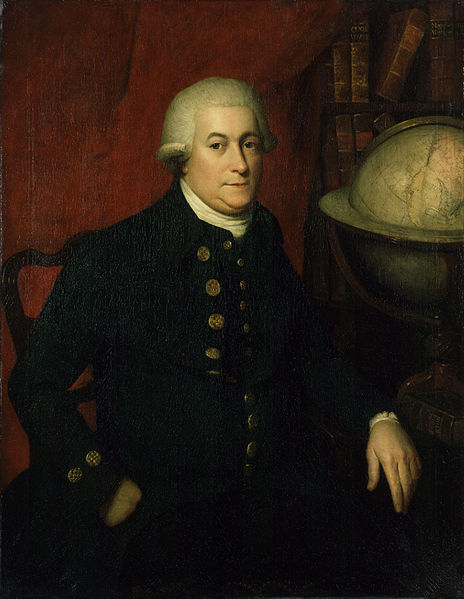
George Vancouver, NPG
The city's name was taken from one of the early explorers to the area, a naval Captain named George Vancouver. He explored the area in 1792. His was the second European scouting party to explore the area. The first was a Spanish Captain by the name Jose Maria Narvaez. Vancouver's party surveyed the Strait of Juan de Fuca, and they were there to map the entire west coast all the way up to Alaska. This work was accomplished in small oar and sail-propelled boats so that they could get into the smaller and shallower inlets without difficulty.

The major river of the area is the Fraser River, named for Simon Fraser, who was the first European to reach the area by land. He travelled to the area along the river now named for him, in 1808. The river became one of the leading routes for those who came into the area for the Frasier Canyon Gold Rush in the 1860s. It was not as successful as the San Francisco or Yukon Gold Rushes, but it brought many Europeans into the area. Because of the Gold Rush, the Province of British Columbia was formed from the unincorporated western area at the time.

The first non-native settlement in the Vancouver area was about 1862, in the Southlands area. The original main settlement, Gastown, was started on the west edge of the Hastings Logging Mill. It started with a tavern created by the millworkers in 1867, which was soon joined by other stores and hotels. Eventually it became a townsite that was named Granville, BI. Shortly after the railroad was started in the area, it was renamed Vancouver, and was incorporated as a City in 1886.

City of Vancouver, 1898
The railroad caused quick growth to the city, and provided easy travel to the eastern provinces of Canada. Immigration from eastern Canada and Europe increased greatly, and also many Chinese immigrants chose to settle there.

Vancouver's port quickly became significant as a link in Britain's global trade network. After the Panama Canal's completion in 1914, it became even more important. The city was then able to compete with the major international trade ports around the world, giving another alternate route to Europe from Asia.

This would have been the year before my Grandmother, Merle was born. Which means she grew up in a flourishing, global city. And it showed in the family she married into. Merle's parents, Daniel and Eliza Jones, had both come to Canada from Wales. Daniel in the nineteen-teens, and Eliza in the late 1800s. George, on the other hand, was born to a much more multi-cultural household. George's father, Bjarne, was from a Norwegian family who had immigrated from first Amsterdam, then settled for a time in Hull, England before immigrating to Vancouver, BC. His mother, Mary, was born in Philadelphia, PA to Irish immigrants. The family moved to Ireland for a year when Mary was in her late teens, then to the Vancouver area in the early nineteen-teens.

In 1919, the Canadian National Railway station was completed. My great grandfather Daniel worked for the Railway, even making a point of asking the railway workers along the way to look after his daughter when she went to join my grandfather while he was training in the east. It was named Pacific Central Station, and provided links down into the US to Seattle and Portland, and via those down to California, and also the most direct route across Canada.

Robert and Lizzie Park with friend, at Mary's wedding, 1911
British Columbia was the second-most populous state for Irish immigrants according to the 2006 Canadian Census. Many came to Canada during the potato famine in the mid-to-late 1800s. My grandfather's mother's family, the Parks, were northern Irish. They left before the country was partitioned. They were protestant, which was true of many northern Irish, and I think coming to the US was their way of trying to escape the growing tensions at home. When things became difficult in Philadelphia for Irish immigrants in the early 1900s, they returned to Ireland. It was only the fact that Vancouver was a growing mecca for many immigrant groups that drew them to the city; along with a letter from one of their children touting the beauty of the area. As citizens of the UK (at least, I believe they were at the time), they were automatically naturalized as Canadian citizens when they arrived. It made the move quite easy, despite being halfway around the world from home.

Gabriel Howells and family ca 1885
Welsh immigrants, on the other hand, are far more populous in Alberta and Saskatchewan, though they are all over Canada. My great-great grandparents, Gabriel and Selina Howells moved to Saskatchewan to live on Gabriel's brother's farm. They moved soon after, settling in Winnipeg, but their children soon began to move west, all settling in BC, and most in and around the city of Vancouver. My great-grandfather, Daniel, came to Canada from Wales as a young man for a trip with friends. Though he meant to come only for a visit, upon meeting my great-grandmother Eliza, he chose to stay, and only returned home to Wales for visits. Again, as citizens of the UK, Daniel, Eliza and her family were all automatically naturalized citizens of Canada.

My Norwegian roots are a little murkier to me, as I am uncertain whether my great-great grandparents, Henrik and Leonharde (Henry and Harde) Bordewick, became Naturalized UK citizens while they were living in Hull, England, or whether they did not become Commonwealth citizens until they settled in Vancouver. I do know that as a fisherman, the West coast provided a great opportunity for Henry, and the community here was very much the home they had been looking for over a number of years, after several stops from their original home in the Lofoten Islands.

McGill University College of British Columbia, the oldest university in BC, changed its name to the University of British Columbia the year my grandmother Merle was born. The population of the campus was greatly diminished by the call to arms during World War I. By the end of the war, almost 700 members of the university had enlisted. In 1920, two years later, the university had only three faculties: Arts, Applied Science, and Agriculture, and only awarded the degrees of Bachelor of Arts, Bachelor of Applied Science, or Bachelor of Science in Agriculture. At that time, there were 576 male students and 386 female students, with only 64 academic staff, only six of which were women. In 1922, the student body had risen to the number of more than twelve hundred, and they marched to push the local government into expanding the campus. Their cause was successful, and the campus was moved to Point Grey, with the first lectures there starting in 1925. Unfortunately, the depression had a bad effect on the campus, and their funds were cut drastically, to the point where many staff posts remained vacant, and several of the faculty lost their jobs. In addition, most graduate courses were dropped. Things were beginning to improve just as World War II broke out. At the close of the war, the numbers in the university increased dramatically, growing almost exponentially, and causing great expansion of both classes and campus.

In 1918, the year my grandfather George was born, the Vancouver General strike happened. It was the first general strike in Canadian history, protesting the killing of a draft dodger named Albert Goodwin. He had called for a general strike in the event any worker was drafted against their will. In response, a group of returned soldiers stormed the offices of the Vancouver Trades and Labour Council. They attacked the Council secretary, Victor Midgely and forced him and another man to kiss the union Jack. One of the women in the offices also received minor injuries when she prevented them from throwing Midgely from the window. The city's reaction against the strike was strong, and the leaders resigned due to the backlash. However, they were nearly all re-elected shortly after, showing that within the union their support had been strong, and not influenced by outside forces. Vancouver was the only city in BC that took part in the strike. Many other strikes also took place in the city that year. It was an important point in the Canadian labour revolt that peaked with the Winnipeg General strike the next year. Another Vancouver strike in sympathy with Winnipeg became the longest general strike in Canadian History.

George and Merle on their wedding day ca 1939 with his grandmothers Harde and Lizzie
This was the liberal, growing, thriving city my grandparents grew up in. Both grew up in protestant households, attending regular services on Sunday, and both got involved in youth groups in their churches. It was this that led to their meeting as teens, and the two quickly became an item, dating until the late 1930s, when George joined the Canadian Armed Forces. George asked Merle to marry him, and she said yes. The two were married at her parents' house in 1939, and then Merle and George headed for the east where George was trained. She stayed with him there until he was sent to the front, and then returned home, where she gave birth to the first of their four children.

He returned from the war and settled into civilian life, becoming an accountant. He and Merle had four children there together before George began to search for a new job in the late 50s. He eventually found the family a new home in Bellevue, Washington and they moved in 1960. However, even after their move, the family visited their fair home city quite often, and still do even today.

Sources:
Bordewick Family History

Surname Saturday 2.0: The Howells/Gabriel/Howels

The Howells Family

Of my Welsh family lineage, the Howells are the best tracked. My mother's maternal grandmother came to Canada when she was still young, but she and her family never lost touch with those branches who remained behind in Wales.

My knowledge of this line starts in Northern Wales with a man called Gabriel Howel. He was born in the late 1700s, and by family lore did some business as a weaver as well as farming. Apparently this was a common talent in this branch of the family. His son married the granddaughter of one of the major Welsh Quakers of their day, and their eldest son was my great-great grandfather, Gabriel Howells.

Though I can only speculate at this stage, I believe that this line may have descended from Huguenots who had escaped France's purge of their religion. I had not known anything about this part of the family line until my aunt mentioned it to me one day on a drive to visit my grandmother. After returning home, I looked up the possible lines, and searched for "Welsh Huguenots" and discovered a mention of a group of Huguenots who settled in northern Wales and became quite well-known in those parts for their weaving abilities. Between the connection of weaving in the Howells line, and Gabriel's name, which is decidedly French and was passed down through several generations, I believe this may well be that line.

Welsh genealogy is an odd beast. I'm used to family surnames that generally remain intact over countless generations, as well as the Scandinavian Patronymic system. But not all Patronymic systems are the same. In Wales, the practice has changed a few times due to laws created by the English to try and "get those damned Welsh in line." At least, that's my belief. But for some families, at least, there is one consistency: instead of the children all taking on a version of their father's name as their surname, only the firstborn son does. Or, at least, that's the way it works in this branch of my family tree.

Unfortunately, aside from the Howells, I have little else to go on. This is the only one I have full information on more than three generations. But those generations are very telling. My progenitor, Gabriel Howel (sometimes Howell) had at least two sons. The elder, my ancestor, was named at birth Howel (or Hywel) Gabriel. His firstborn, my great-great grandfather, was in turn named Gabriel Howells (with the S at the end to denote "son of"). I'm not sure if his son would have eventually gone by Howell Gabriels or something else, because he died as an infant, and they never named any of their other children that way.

So as you can see, it makes looking up records quite confusing. In some records, the children are listed with their parents' surname. In others with the one they would use as an adult. So it makes it very difficult to find the appropriate records.

Still, I'm muddling my way through it. After all, I managed to find the original Gabriel Howel's wife and a second son who was apparently named for her side of the family—Evan. I'd love to find more, though. And I do keep trying.

The Howells line is as follows, for those interested:

* My earliest known ancestor in this line was Gabriel Howel, farmer and weaver in northern Wales, born between 1794 and 1796. He married Gwen Evan sometime before 1822, and the couple had at least two sons (and likely several more children) in Merionethshire in northern Wales.

* The two children I have are Howell Gabriel, born 1822 in Dogelly, and Evan Howel, born 1827 in Towyn.

* Howell married Catherine "Catti" Jones sometime before 1849, and the two had at least 8 children.
> Gabriel Howells, born 1849, married Selina Roberts. Their descendants will follow in the next point.
> Howel Gabriel, born after 1852, married Margaret Owen, and they had at least one daughter, Gwen, born 1892. It is possible his wife's name may also have been Lillian, or that Lillian may have been her first or middle name, though I am uncertain of this at this time.
> Catherine Gabriel, born sometime after 1854, who died in her teens.
> Evan Gabriel, born about 1855.
> Edward Gabriel, born about 1857, married Catherine Thomas.
> Lewis Gabriel, born 1859, who moved to Canada, settling there on a farm in Manitoba or possibly Seskachewan. He married (not sure if they married in Canada or Wales) Sarah (I have no last name), and they had three children: Winnie, Howell, and Ap Cell.
> Hugh Gabriel, born about 1864, married Catherine Norris, and I believe they had four children: Mary Catherine, Hugh, Drynwen, and Celt. I know Celt married a woman named Joan, but have no other information on this line.
> Gwen Gabriel, born about 1870, married Griffith Roberts, and they had at least two children, a girl named Cattie (possibly Catherine?), and a boy whose name I do not know.

* Gabriel and Selina had 8 children. Ellen Catherine and Howell Gabriel Howells both died in a whooping cough epidemic within days of each other in 1877. The others all lived to adulthood.
> Selina Jane, born 1878, married Thomas Cockrill, and the two had six children together: Selina, Mary Ellen, Catherine Elizabeth, Violet, Tom, and Edward. I know that there are descendants of this line, or at least that there were marriages for three of the four girls, but I know nothing more than their husbands' surnames. Selina died in 1965.
> Gwen Mary, known in adulthood as Winnie, born 1880, married James Kay, and they had three children: Gwen, Marguerite, and Hugh Ross. Gwen and Marguerite married, and I know that Marguerite had grandchildren, though I am uncertain if there have been more descendants in this line. In 1944, Winnie married again, this time to a Rich Curtiss. Winnie died in 1956.
> Hugh Cadvan, born 1883, married May Tait, and the couple had one daughter, Ethel. I believe she was the last in this line. I do know that uncle Hugh served in the RAF during World War I, but know nothing of his record. Hugh died in 1942.
> Eliza Anne, known to everyone as Bess, was born 1885, married my great-grandfather, Daniel Thomas Jones in 1911. They had three daughters and one son, who will follow below. She died in 1980.
> Catherine, born 1887, married Robert Thomas Williams, and they had four children. I am uncertain at this time if they have further descendants. Catherine died in 1937.
> Edward Gabriel, known as Ted, was born 1891. He married Esther Vanadestine Henderson, and they had three children: Earl, Margery, and Bill. I do not know if there are other descendants in this line. Ted died in 1981.

* Eliza and Daniel had four children:
> Marjorie Grace Jones, born 1912, married Herbert "Bert" Robinson, and the two had three daughters and have a flock of descendants today spread around the Northwest and throughout the US and Canada. Their first great-great grandchild was born this year.
> Edwina Hanna Jones, born 1913, married Kenneth Merilees, helping to raise his two sons and had a third with him. Their boys have four children between them, and three grandchildren.
> Merle Tydfil Jones, born 1915, married George Bordewick. My grandparents had four children, two grandchildren, and their second great-grandchild was born last year, who my grandmother got to see several times before her death this year.
> Ivor Howell Jones, born 1920, married Marjorie Carnahan, and they had two children, who have four children and seven grandchildren between them. After his first wife's death, he married Mary Nixon. He died in 2005.

What I don't know:

* How many generations the Gabriel/Howells clan was in Wales before my ancestor Gabriel Howel.

* How many children Gabriel and Gwen had . I would love to learn more about their family in general.

* What boat the Howells emigrated to Canada on. I know they lived with Lewis's family on their farm for a time before moving to Winnapeg, but beyond my grandmother's stories and assorted Census forms, I know little more about this part of my ancestor's lives.

* When the various Howells children moved to Vancouver, and when Gabriel and Selina moved there. I do know they lived there for some amount of time before their 50th anniversary, which was celebrated by the entire clan in Vancouver BC.

Other information about this branch of the family:
Brick Wall Posts -
Brick Wall Update
Brick Wall Update
Brick Wall Update 2012
Old Surname Posts
Howells
Where We're From Posts
Where We're From – Canada
Where We're From – Wales
Where We're From – The Unknown
Other -
Four Generations
Gabriel Howells
Testimonial to the Howells
Women's History Month – Week 2
My Nain – Eliza Anne Howells
Saturday Night Genealogical Fun

Brick Wall Update 2012

It's been a while since I updated my brick wall search. While I haven't gotten much further on some branches since my last update, I think they will go on the back burner, so that I can focus more on getting information on my great-grandparents and their parents, and leave any more researched lines out for now.

So here's my Brick Walls as they stand:
The Seneft/Senft/Hilingers
I still haven't determined where exactly Sedziszow, Galicia is. I have a few possible locations, all in various parts of Galicia. I seem to come up with new places in Poland every time I look up the town. At the moment, I'm inclined to believe that they lived in the area north of Krakow (the blue tags are all possible locations that come up when I look up the town name.)

I also don't know if Alec's siblings were all born in that same town as he was, or what his second brother's name was. I do have a couple of relations I should try to get into contact with to see if they have that recorded somewhere.

I do not know when the Senefts moved to England, only that they were there before World War I. I have a record for a gravesite for "Minne Seneft" in London, with a transcription reading "Loving daughter Jennie," which may well be Alec's mother Mindel and his sister Jennie, which means they would have been there before 1913, when the grave marker says she died. This fits in with them having left in the late 1800s sometime, so I'm inclined to believe this is her.

I know the fate of three children if I include Alec. I have a record of Jennie's immigration to the US in 1916. The record also includes the name of her brother, Jack, who I know was also already in New York City at the time, and her father's name (Leon) and his address in London. I also think I have found a gravesite for Jack in New York, though I have not confirmed that grave, either.

Alec was sent to Camp Douglas, though whether he was sent there alone, or others of his family went there as well, I'm still not sure. We currently have three photos of Alec while he was at the Camp (though one I'm less certain of than the other two), both of which are addressed to his brother Jack.

We also have a family book about Alec and Dora's family which includes a few details of their parents' lives, including Alec's mother Mindel, though all it really mentions is that she was last living in London. Leon is not mentioned at all because by the time the book was written up, Alec had reverted to his mother's surname as his parents were married only in a religious ceremony, and their offspring were therefore not recognized as legitimate by the German government.

The last formal record I have of Leon is his name on Alec and Dora's wedding invitation, which means that I know he was alive in 1919, and my grandfather stated he was dead by the time he was born in 1922, so I am still looking for some kind of grave marker for Leon in London, as I believe he lived there until his death. I know he was a Rabbi from family stories, so he may have been buried someplace special, but for now, that's all I have.

I wish I could find more record of the Senefts in London, and even more information about Alec's time in Camp Douglas. I'd love to know more about Alec and Dora's life in Frankfurt, but likely most of those records were lost during the war, and I'm grateful for what I do know, at least.

As for Mindel and Leon, I have no record of them before London. I hope at some point, I'll find something, but for now, I think that's unlikely.

The Kresch/Reich family
Most of what I know about Dora's family, I've learned in the last two years, and comes from a couple of photos and the family book.

I know that Dora was born in Czudek, a small town in Galicia (now Poland) near Rezeszow, and her father seemed to be a teacher according the family book. I know that she had at least one sibling, though relations have mentioned she had more. I only have the name for one, though, her sister Minna, who came to Frankfurt with her shortly after World War I.

I believe their father, Benzion, died before the girls moved to Frankfurt, though not sure when exactly. Their mother, Fiege Golda (not entirely sure what she went by), moved to Frankfurt at some point. Not sure if she moved with her daughters, or later to be close to them. I believe she lived in Frankfurt until she died in the late 20s or early 30s. I do know that she was also on Alec and Dora's wedding invitation, but her husband was not. This means she was alive in 1919 definitely, while he was likely not.

Unfortunately, both Kresch and Reich are far more common than Seneft and Hilinger for this area, so in this case I actually suffer from an excess of too many records, and not being able to narrow things down enough, even with a specific location for Dora's birth.

And like Mindel and Leon, I know almost nothing about Benzion and Fiege Golda before their daughter's birth.

I think my main problem with both families is that names were very fluid in this time and area. Both in writing and in how they were referred to. In formal records, you used one name, in every day life, another, so depending on who was writing the record, you would see a very different name. Not to mention the language barrier of the Hebrew/Polish/German mix, along with other dialects spoken in the area. I'm working on getting it all sorted out, but it will definitely take time to do.

The Rasmus Hansen family
This branch is going on the back burner. I've managed to get a better record of Rasmus's parents. I've found him and his parents in three separate census records, and on Maren Sofie's side, I have both her parents as well, if not precise records at the moment. It's enough for now.

This will probably get some attention anyway, though, because I'm slowly piecing together Oline's life for the book I'm writing about her, so more research will need to be done at some point.

The Park/Curran family
This one is also going on the back burner. While I haven't gotten any further on the Park side, I have managed to get the names of both of Elizabeth Curran's grandfathers. And I'm definitely back before my great-great grandparents, even if not in great detail, so I think I can wait on this branch a little longer.

The Jones family
This is the last of the family branches I'm going to focus on now. Most of what I know of this branch comes from my aunt and my grandmother, and family photos. But I know almost nothing about my great grandfather's parents before his birth.

I have birth dates and locations locations for both. Benjamin was born in 1865 in Caio, Wales, and Hannah was born Hannah Griffiths in 1863 in Newcastle Emlyn, Wales. I believe both locations are in south western Wales, though using Google Maps has not helped much, as each time I look, I seem to find slightly different information, and at least one of the two seems to have more than one possible location. For my current assumptions, click here.

I believe they married sometime before 1882, and at some point the couple moved together to Merthyr Tydfil in South Eastern Wales where they had seven children. I believe all of them were born in Merthyr Tydfil, and that Daniel, my great-grandfather, was the eldest.

Both their first and last names are incredibly common, which makes finding them without more specific information almost impossible at the moment. Trying to narrow down the areas of their birth is nearly impossible, even though I have locations for both. It hasn't stopped me from trying, but it is making it very difficult. I just wish I knew at least one sibling or parent for each of them. It would help narrow things down a lot.

I suppose my next step for this branch will be to get a subscription on a British site to get access to British birth, death and census records.

The Gabriel/Howells/Roberts Family
Another branch that can wait, as I have quite a bit of information on this family. Less so on the Roberts side, but that's still a step further back than I need to go right now.


As always, any help with any of these branches would be greatly appreciated.

Advent Calendar: Gabriel Howells

Gabriel Howells (Gabriel)
(the Welsh naming system is patronymic for the first son in particular, so at birth Gabriel's name was Gabriel Gabriel. I'm uncertain of when his name became Gabriel Howells as of yet.)

Born 1849, Died 1934, aged 84
Lived in: Towyn, Wales; Celynin, Wales; Barmouth, Wales; Penrhiwceiber, Wales; Manatoba, Canada; Vancouver, BC, Canada
Married: Selina Roberts
Children:
Ellen Catherine Howells
Howell Gabriel Howells
Selina Jane Howells
Gwen Mary Howells
Hugh Cadvan Howells
Eliza Anne Howells
Catherine Howells
Edward Gabriel Howells

Gabriel Howells was born in Northern Wales to Hywel Gabriel and his wife Catherine Jones, their first-born son. Hywel was a weaver and farmer, and his quilts were much sought after. As a young man, Gabriel was apprenticed to a stone-mason, and made a fairly good living at the trade throughout his life. In 1874, he married Selina Roberts, and the two started a family together. After their first two children died of whooping cough, the family moved away from the area, and came to settle in Southern Wales where the rest of their children were born. He worked in the mines there, building supporting arches until he decided to move to Manatoba, Canada at the urging of his brother Lewis. The families lived together there for some time, two large families in one small house. After a time, Gabriel decided to move his family to Winnapeg, preferring to live by his trade rather than by farming, and the family settled there, the children moving away as each married. In 1906, he and his wife made one final move, settling near several of their children who had settled in Vancouver, where the climate was much milder. The two lived there until their deaths.

Testimonal to the Howells

I should start this entry by saying I grew up in a non-religious home. My father's father was Jewish, but after they came to the states, and especially after the war, he didn't really practice his faith. His wife was Lutheran before her mother's death when she was 9, but after, her father had too much else on his mind to take his three children to church every Sunday, so she grew up in what basically became a non-religious household herself, only attending a Methodist church during her schooling because it was required by the school precepts that she attend some service or other on Sundays.

So when my mother married my father, he was already non-religious, and the two of them chose to raise their children the same way, even though she had been raised in a Methodist church her whole life to that point.

It's made things both easier and more difficult for me when it comes to religion—I've had the freedom to choose, and have experienced a few different churches over the years with friends and even been to synagogue several times. In the end, I chose no religion over settling into one. Mostly because of one particular bad experience (a subject not destined for this blog), but also because I have yet to find something that really shows faith the way I see it. As something personal between me and whatever is out there guiding the universe.

In some ways, you could say that Genealogy has become my religion. It's not. Not in the traditional sense. But I'm more inclined to let thoughts of what my ancestors might have done in this situation or that guide me in making my own choices, or helping me understand those choices better. Not that much different from how a traditional religion might guide one, after all.

But because of the above, I've never really felt the community of church. I didn't miss it, because I never had it, but stuff like the below transcripts surprises me because I just never think about the small bits that make up a church the way that someone who attended one all their life might.

I didn't even know this transcript existed until I received a copy from one of my mother's cousins. It was written to my great-great grandparents shortly before they left for Canada.


TESTIMONIAL TO MR. GABRIEL HOWELLS


Presented by the Church, the congregation, and the Methodist community of PENUEL, Penrhiwceiber, South Wales.

Dear Brother and Friend.

We were very sorry to hear that you and your family are leaving us and going to Canada, and it would not be worthy of us as a church and congregation if we did not show some recognition of our affection and love towards you.

It is with satisfaction and joy that we present you with this testimonial as an expression of our gratitude for your hard work and excellent efforts in all religious areas.

We can at least express our opinion of you as a man of wisdom with a pleasant personality. We always found you true and honest in all your activities. We feel that you have outstanding ability as a Sunday School teacher in teaching the scriptures, and we can assure you, that those whom you taught have happy memories of your skill and dedication in revealing the beauty of the scriptures to them.

You carried out your work as superintendent of the Sunday School with faultfullness and regularity.

We would also like to acknowledge your work as treasurer and advisor to the Sunday School.

The fact that you have carried out these duties with distinction is proof that you are prepared to give your all in the teachings of the Lord.

We hope that you will not just be content with attaining this position, as doubtless you will carry on as we know there will be plenty, if not more service, needed in Canada than in the country you are about to leave.

Our wish is, in presenting you with this testimonial, and a hymn book to your wife and children, that you will enjoy many years of service, and that the light of heaven will shine upon you.

Therefore, dear brother, be sure and steadfast, and ever abundant with the Works of the Lord, and you will know that your efforts will not be in vain.

ON BEHALF OF THE COMMITTEE
Thos. J Edwards -- Minister (Preacher)
Ebenezer Morgan -- Chairman
David Davies -- Treasurer
Ebenezer Pughe -- Secretary

Penrhiwceiber March 1892

Gabriel Howells

In talking to my aunt in hopes of finding an original copy of the Jones family tree, she came across this paper, which I'd never heard of before. I couldn't resist typing it up this week. This is the side of the family tree I haven't really sorted out in my head yet.

The Welsh were constantly finding ways of getting back at the English for the oppression of being under their thumb—including using patronymics to confuse them.

I really don't have a lot of this tree—pretty much non-existent more than three or four generations back. I need to figure out what I know and what I still don't on this side.

So far as I can see, there's no credit on this, nor did my aunt know where it came from. It's possible it was written by my grandmother's brother Ivor, or her sister's husband Burt, or their uncle Ted. We just don't know for sure. There is a decided religious slant to the entire thing. As well as being very patriarchal. Almost no mention is made of the women of the family, and certainly nothing before my grandmother's great-grandmother, though the stories go back much further.

Gabriel Howells

Born August 1, 1849
Died December 9, 1934


Gabriel Howells was the eldest son of Hywel and Catherine Gabriel, who lived at Llanfilan-gel-y-Pennant near Cadair Idris, a mountain in Merionethshire, North Wales, meaning "Idris' Chair." He was probably born there, as it is known that by 1856 his parents had moved to Ty-Cerrig, a small farm near the beach at Llangelynin, a district between Towyn and Llwynril, two seaside villages in Merionethshire. His father, Hywel Gabriel, was of a well-known family of weavers that settled early at Llanfihangel-y-Pennant. He was noted for his skillful and artistic weaving, and his work was much sought for by the gentries of the Manor homes of Merioneth for cloths and damask quilts. He farmed Ty-Cerric, but kept one building at the end of the house to do his weaving in. Later the family moved to another small farm in the neighborhood, and it was here that he died at the early age of fourty-nine, in 1871, at Castell Back, Rhoslefain.

His mother, Catherine Gabriel, was also of a well-known family, from the district of Dolgellau. She was a grand-daughter of Lewys Edwart, "The Quaker." He was well-known for his graciousness and kindness, and also for his pre Christian conduct and strong principles. He loved, in his spare time, to write poetry. There are many verses of his to be found today. He was a well-known carpenter, and some of his credible works are seen today in the neighborhood. As a Christian he belonged to a small flock of Quakers that flourished in the district at that time. He also preached, or gave advice, for the Quakers. It is said that he was the last to work in this capacity for the Quakers in the parish of Dolgellau. He was also a renowned stone mason. His chief fete was in the building of a certain part of Barmouth Harbour—the part that is called "Brother Isle." It was also his work in widening the bridge over the Winon River at Bontnewydd three miles from Dolgellau. He had eight children. His son Evan helped him with his work. He was with his duties at Hengae, Aberllyfenni—dozens of miles from home, when he slipped down a ladder while he carried a heavy stone, and wad (sic) badly hurt. It was intended to take him home, but his condition deteriorated so much that they turned into a farmhouse, Hafod-y-Merich, where he died about 1815. He was buried near his home at Tyddyn-y-Garreg. As it is the Quakers' custom not to put a gravestone, there is nothing to show the exact spot, but legend says it was by the gateway that leads to the cemetery.

His son, Evan Lewis, was born at Rhiwspardyn, Dolgellau, in the year 1788. His father gave him the best education he could afford. We heave of him in Aberystwuth in 1807, where he started a school at Little Darkgate Street, and was there until 1820. While he stayed at Aberystwyth, he started preaching with the Free Weasleyians. He was called by the well-known church of Cilgwyn, near Llangybi, to administer one of the oldest Independent Churches in the south. He was ordained pastor there in 1829. Among others that officiated at the ceremony was Prof. David Lewis Jones, Carmarthen College. He was pastor of the chirch at Cilgwyn for fourty-four years. Apart from being a pastor, he kept a school at Llangybi, and taught there. He also worked hard with the Sundqy School, and did all in his ability to encourage education. He preached freely in Welsh and English, and traveled far and wide through Cardiganshire to encourage the warmth of the Gospel of His Kingdom. Every time he visited Aberystwyth, the church would be overflowing. He started a book on "Arithmetic Made Easier," but only one edition was published. He was not an Unitarian, though he occasionally preached in the Unitarian pulpits. The congregation at Cilgwyn were a mixture of Independence and Armenians at first, but eventually they belonged to the Free Wesleyian Church. He was a bosom friend of Black Daniel of Cardigan, and Davies of Howel Castle. His services for religion and education were acknowledged by the Government. He was granted Five Pounds yearly by the Lord Chancelor, and another Five Pounds yearly by the Independent Fund through the Rev. David Lloyd, Carmarthen. He died July 28, 1864, seventy-eight years old, and was buried at Ystrad Cemetery, Cardigan, having been a good and faithful worker.

A grandson of Lewys Edwart was Lewis Jones, brother of Catherine Gabriel, but known in her own locality all her married life as "Catti Jones." Both were born at Caerberllan Mill, which lies between Abergynolwyn and Llanfihangel-y-Pennant. Lewis was born in 1812, and Catti in 1825.. He went to Bala to be apprenticed as a book binder, but soon after settling in Bala, he started to preach when he was only nineteen. He went to Wrexham for his education to the Rev. John Hughes. He was ordained to the ministry at Bala C. M. Association in 1838. He wrote many articles to the "Essayist" in the years 1845-1851. He published some books, one being the "Memoirs of Rev. Richard Jones, Bala;" and a catechism of "The Last Hours of Jesus Christ." He had hoped that the catechism would serve as a study for membership of the Fellowship. It went through many editions. The "Essayist" commended it favourable, and praised the high standard of Welsh used in it. Among other praise-worthy comments were by Dr. Lewis Edwards, Bala; Mr. Parry, Bala; and the Rev. Edward Morgan. For years he lived in the house belonging to Llwyn Einion Chapel, but moved later when his health deteriorated, to Bala. The roots of Independence had gone deep to his body and character. He had arranged that he should be buried in Llidiardan Cemetery, by the foot of Arenig Mountain, that he could rest in peace in the neighborhood of Chapel and Independent Cemetery. He was a keen thinker and was a man of strong principles and convictions. He and Dr. Lewis Edwards, Bala, had been very friendly all their lives, and were drawn closer together as time went on. This is what Dr. Lewis Edwards said of him after he passed away: "He wrote some articles to the 'Essayist' and among them was 'Christ's body, the Home of Godliness,' which, as I am told, was such a blessing to Mr. Parry of Chester that it killed his prejudice towards the magazine forever. Among other works he wrote were a number of articles to the 'Pennyworth,' known as 'The Letters of an Old Mountaineer,' and it is a pity that these and other articles could not be published in a book." Dr Edwards also praised him as a suitable man to lead at Church Festivals. He could lead the saint along happy paths to the spiritual and everlasting home. He also had a strong grasp of the teachings of theology. He leaned more towards the New Theology than Dr. Lewis Edwards. The Doctor stuck to the old teachings, but Lewis Jones studied the more modern teachings of his generation. Dr. Edwards always encouraged anyone that wished to learn Modern Theology to study the writings of Lewis Jones. He died young in 1854 of T.B. He is buried at Llidiardan. Though his life was short, he used it to the full, and worked hard.

A grandson of Lewis Edward was Rev. Lewis Jones, Bala, being a brother of Catherine Gabriel, mother of Gabriel Howells. As was then a custom in Wales to name the eldest son the surname first, so he was the same name as his grandfather, Gabriel Howel, a bellringer at Llanfihange-y-Pennat, who died in 1852, aged fifty-eight. His (Gabriel Howell's) parents belonged to the Independent Church in Wales, and used to worship at Nazareth when there was a service there. Otherwise they would woalk together to Llanegryn, a distance of four miles. There was a family of six sons and two daughters: Gabriel, Lewis, Evan, Edward, Howel, Hugh, Catherine and Gwen. Lewis and Edward sought their fortunes in Patagonia and Canada, but Edward returned home to his widowed mother to farm Castellmawr, where she had moved to the largest farm in the district, with two other sons, Howel and Hugh. Edward remained at Castellmawer for the rest of his life. Howel and Hugh having married and sought farms elsewhere. Edward's family still remains in the old home. Catherine died young, having gone to the English town of Birmingham to seek employment. She died sixteen years of age. Gwen married young, to a farmer, and had a son and daughter.

Gabriel was apprenticed to a stone mason, and some good work of his is today a testimony of his thoroughness in the neighborhood. He married Selina Roberts of Dyffryn Ardudwy, and settled down there. Unfortunately he lost two of his eldest children at Dyffryn. One was two years nine months, and the other was seven months old, having had whooping cough, and both were buried the same day. It was a terrible blow, but the family grew, three more children following. The work was scarce around Dyffryn, so having a young family to feed, he moved to South Wales, where many North Wales families moved to get a living at the coal mines. He build stone arches in the coal mines. Probably they are there today. He settled down at Penrhiwceiber and had three more children. Meantime his brother, Lewis, had settled down in Canada and as coal mining was not very healthy work, he urged his brother Gabriel to join him in Canada. Eventually he sailed with his young family (Selina, Winnie, Hugh, Elizabeth, Catherine and Edward) in March 1892, and arrived to join his brother in farming at Millbrook, Manitoba.

The farming did not get on very well, so he resorted to his old job of stone mason, and eventually found a home for his family at Winnipeg in 1893, and found plenty of work there in the summer months. Later he did contracting. But the winter is so long at Winnipeg that he decided in 1906 to go to Vancouver, as some of his children had gone there and had praised the better climate of British Columbia.

So here he and his wife lived as a king and queen among their family, loved and adored by their children and grandchildren, to a ripe age. His wife predeceased him in March, 1933, at eighty-seven years of age. There was not much left for him afterwards, so he followed her in December, 1934, aged eight-five years.

Those of his children still living are Selina, aged 82; Elizabeth, 76; Edward, 70. Winnie passed on in 1955, aged 75; Hugh in 1942 at 59 and Catherine in 1937 at 49. Selina married Thomas Cockrill in 1899, and they had four daughters and two sons. Winnie married James Kaye in 1911, and they had two daughters and one son; widowed, she married Rich Curtiss about 1944. Hugh married Mary Tait in 1906, and they had one daughter. Elizabeth [ed. Eliza was actually her given name; we believe she just preferred Elizabeth to her own] married Daniel Thomas Jones in 1911, and they have three daughters and one son. Catherine married Robert W. Williams in 1918, and they had three sons and one daughter. Edward married Esther Henderson in 1919, and they have two sons and one daughter.

---O-O---


A cousin of Catherine Gabriel [nee Jones] was Mary Jones, whose efforts resulted in the founding of the British and Foreign Bible Society. She was born in 1784 at Llanfihangel-y-Pennat. At sixteen, after having saved diligently for six years, she set out on a twenty-five mile journey from her home to Bala, which was the nearest place where a Bible could be purchased. She left home at daybreak and arrived at her destination at dusk, having walked all that way bare-foot, so as not to wear out her only pair of shoes (which had to be made-to-order in those days). At first she was told no Bible was available, but her disappointment and grief were so apparent that Mr. Charles could not deny her, and managed to obtain one for her. Her story is well-known throughout the Christian world, and a monument is erected to her memory in North Wales.

---O-O---


April, 1961.


Gabriel and Selina Howells's 50th Wedding Anniversary with all their children and grandchildren
1921, Vancouver, BC
Back: L-R: Jim Kay, Selina Cockrill (nee Howells), Esther Howells (nee Henderson), Ted Howells (behind Esther's shoulder), Mary Ellen Cockrill (behind and between Ted and Violet), Violet Cockrill, Winnie Kaye (nee Howells) (behind and between Violet and Cassie), Cassie Cockrill, Selina Cockrill (nee Howells) (behind and between Cassie and Eliza), Eliza Jones (nee Howells), Thomas Cockrill (behind Eliza and Catherine), Catherine Williams (nee Howells), Daniel Jones (behind Catherine)
Middle: L-R: Tommie Cockrill, Earl Howells (on Gabriel's lap), Gabriel Howells, Ivor Jones (on Selina's lap), Selina Howells (nee Roberts), Eddie Cockrill, Alan Williams
Front: L-R: Marguerite Kay, Merle Jones, Gwen Kay, Edwina Jones, Marjorie Jones

About this blog

This blog is maintained by two sisters who have had a life long interest in geneology.
Mika writes here mostly about our family (Hansen, Hillinger, Bordewick, Park, etc), and her search for more information.
Shannon mostly uses this space as a place to make the many stories written about and by her husband's family (Holly, Walker, Walpole, etc) available to the rest of the family, present and future.

Our blog is named Oh Spusch! mostly because Shannon is bad at naming things. The first post I put up includes a story about the time Walker's great grandfather took his whole family out to see a play and the littlest kept saying "Oh! Spusch!" No one ever figured out what she meant by that.