Showing posts with label Margaret Hansen Hillinger. Show all posts

Happy Birthday, Nana

My grandmother would have been 100 on the 23rd of August this year. She's been gone almost ten years now, and I miss her all the time. She was a great lady, and had a pretty amazing life. In fact, she was one of the first people I wrote about on this blog. I wrote about her mother and how she lost her, and about her war experience, and her husband and children. Her father's family tree is the most extensive line on my family tree. She's just always been a very solid presence in my life.

Margaret Hansen was the eldest of three children born to her parents in Cleveland, Ohio. She grew up there, and seemed to have a wonderful life, with her mother sewing lots of clothes for her, and her father building houses and making a good living at it. Both of her parents were from Denmark, and so she grew up surrounded by friends and family who were also Danish.

Then, in 1929, her mother died, and Nana's life changed. She and her younger brother and sister went to live with her aunt and uncle and a young cousin. Their father built a new home for them, unable to stand the idea of living in the home his wife had died in. He married soon after, and Nana's family went from a small family of five, to a larger family of seven, with two new step sisters. As the one of the two eldest, she was expected to do a lot of chores around the house and take care of the younger children. Between that and the onset of the Great Depression, life became very difficult for her. Her father had a great of difficulty selling his homes, even with the help of his new wife, and fighting was common.

So the moment she got a chance to get away and go to boarding school, she took it. The school was one that trained girls in office skills, and at the end of their schooling, the school and the school trustees would help the girls get a good job. So as soon as Nana ended her schooling, she went directly into a clerk job. She held that job until shortly after the US entered World War II, when she signed up for the army, and became a WAC. When I interviewed Nana about her mother for my paper about her mother, I asked her about how she'd felt about being so important. Being a WAC was something new and unusual. She responded that she hadn't felt special or unique. It was just something she'd felt she had to do. For her, she was so intent on helping the US in the war efforts, she never saw her own role as anything specifically important. But I will always see her as someone very special for that. It wasn't the only special thing she did, but it definitely showed what kind of woman she was, and definitely changed her life.

Later, as a married woman across the country from the rest of her family, she found a new way to make a difference. She got involved with the mothers of several of the children in her kids' schools. First it was just a way to help each other out, but as they grew older, they found ways to help their community as well. They created garage sales, where the proceeds would all go to a charity that helped children of troubled homes. I remember the garage sales growing up, but it wasn't until I was an adult that I realized how much of an organization they had made. They'd bought a storefront in their neighborhood, and used it to sell the goods they collected in between garage sales. Though she has been gone for so long, the shop she helped to create is still there, at least, according to Google Maps. It seems fitting that her good has existed so long. She was a great lady.

It is also because of her that I have such a love for genealogy. After her father's death, her sister became more and more interested in finding out more about their family tree, particularly their mother's side, as they'd lost complete contact with anyone on that side of the tree. They contacted everyone they knew that might have information, then looked into the records they could access to find out more. My great aunt wrote to Denmark in the area that she was listed as coming from, and because of them, we have a much more complete tree than we'd had. I remember my father helping to write up the family trees for all sides of my family in the 80s, and I have also since written up some of Nana and her siblings' search for their mother's family, including visiting with their uncle near the end of his life, who they had not seen since their mother's funeral. I've learned so much more about this line since her death. I do wish I could have shared it all with her.

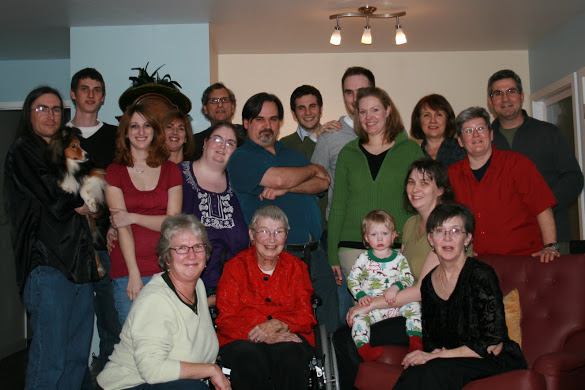
Nana's father died in 1977, and her husband in 2000, but Nana lived long enough to meet two of her four great-grandchildren. This year, to honor her, the family is gathering as best we can to celebrate her life again, and to remember everything she brought into our lives. She has four children, six grandchildren, and four great-grandchildren. So much has happened with our family since she's been gone. I hope, wherever she is, she is smiling down on us.

Some shots of Nana over the years:
 
Margaret and her parents ca 1920
Margaret and her father and little sister ca 1924
Hansen kids with their aunt Helga and cousin Else
Margaret, her cousin Karen, and her sister Marilyn during or right after the war
Margaret and Sam Hillinger at their reception 1948
Margaret with her two boys ca 1953
Me, Dad, Grandpa Hansen, and Nana, ca 1973
Margaret, Marilyn, and their uncle Hans ca 1988
More about Margaret Hansen Hillinger:
• The Gift of Oline
• In Memory of Margaret Hansen Hillinger, 1919-2010
• New Discoveries
• Good Bye, Nana
• A Bit of Genealogy Fun
• Grandmother AKA
• Advent Calendar: Margaret Hansen
• Matrilinial Monday – Margaret Hansen Hillinger
• Saturday Night Genealogical Fun: My Paternal grandmother's Paternal Line
• Hometown Histories – Cleveland – Margaret Hansen
• Visual Family Tree II – Hansens and Ancestors
• Four Generation Photos

Hometown Histories – Cleveland – Margaret Hansen


My paternal grandmother, Margaret Hansen Hillinger, was born in Cleveland, Ohio, US, in 1919.

Cleveland, Ohio skyline, wikimedia commons
Cleveland is the county seat of Cuyahoga County, the most populous county in the state. As of the 2013 Census Estimate, the city itself has a total population of over 390,000. It is the 48th largest city in the US, and the second largest in Ohio. In 1920, a year after my grandmother was born, the population was more than double that size, at 796,841. It was not the largest the city has been, though. In 1950, it reached over 914,000 people. The year after Margaret was born, it became the fifth largest city in the nation.

The city is situated on the southern shore of Lake Erie, and currently covers an area of about 82 ½ square miles. It was founded in 1796, and incorporated as a city in 1836. It became a manufacturing center because of its location on the lake shore, which gave it easy access for transporting goods. These days, the city has quite a diversified economy, which includes manufacturing, financial services, healthcare, and biomedical. Cleveland is also home to the Rock and Roll Hall of Fame and several sports teams, including the Indians and the Browns.

Before the Europeans arrived in the area, several native tribes lived in the area, including the Erie, Wyandot and Ottawa tribes, until at least the mid-seventeen hundreds. It is believed most of the tribes in the area were transient ones, coming and going, or settling only seasonally in the area.

The city got its name from the leader of the group who surveyed the land that would become Cleveland, General Moses Cleveland. He oversaw the plan for the core of the city before going home, and never returned to the area.

Though the city had voted only marginally in favor of Lincoln, when the South began to succeed from the Union, they were quick to rally to Lincoln's war efforts, though there were still some that opposed it. The Civil War was a boom time for Cleveland. Manufacture of railroad iron and gun-carriage axles brought in a great deal of money. By 1863, almost a quarter of all US Naval craft for use on the Great Lakes were built in Cleveland. In 1865, that number had increased to nearly half. The fact that all supplies from the South were cut off caused Cleveland to build its first tobacco factory. And its garment industry also began to flourish due to the German Woolen Factory, which was the first company in the area to manufacture the cloth.

At the end of the war, there was much rejoicing and celebrating, though even then, some still felt that the former slave population did not deserve citizenship, which had been granted to them by Lincoln. It took many more years for the black population of Cleveland to arrive. Most did not start arriving until after 1900. At that time, the Census Bureau estimated the Black population of Cleveland at just over 4000. By 1930, it had risen to over 70 thousand, most of whom had arrived during the twenties.

The May Day riots happened the year my grandmother was born. These were a series of violent demonstrations all over Cleveland on May first of that year. Eugene V Debs, a Union leader, was arrested for denouncing US participation in World War I. He was convicted under the Espionage Act of 1917, and served until his sentence was commuted in 1921. Charles Ruthenberg, head of the US Communist Party at that time, organized a series of protests that quickly broke into violent clashes with other groups. When things calmed, two people were dead, and forty injured. 116 people, including Ruthenberg, had been arrested. The city government quickly passed laws that restricted parades and specifically red flags, which had been one of the inciting points of the riots. It is seen as the most violent of the civil disorders that happened at the time, a result of the first Red Scare.

My great-grandmother, Oline, would have been about halfway through her pregnancy then. She and her husband, Holger were both Danish immigrants who had not yet even been naturalized. I can only imagine how they must have felt about all this. I'm sure they kept well away from the worst, but even living in the city would have made it quite alarming.

Margaret with her parents ca 1921
Oline and Holger immigrated to America in the early 1900s. He settled in New York, and she in Chicago. They met on a trip back to Denmark to visit family. They married a few years later, settling in Cleveland. By 1930, there were about seven hundred Danes in Cleveland. Margaret and her siblings grew up in a very strong Danish community; one which included many of their extended family members. Her father, Holger, built houses with the help of many of his Danish friends and family from the old country; many of which still exist today in Cleveland.

The family flourished in Cleveland, and in 1923, Margaret had a sister, and in 1925, a brother. Holger's homes sold well in the increasing population, and Oline sewed and cooked and took care of their family. Unfortunately, in early 1929, Oline fell ill, and soon died of pneumonia. Holger was devastated. He packed his kids off to live with his brother and sister-in-law, who lived nearby, then began to work on a new home for the family. He couldn't bear to live in the same house where she had died.
ca 1929 - back: Helga; middle: Margaret, Marilyn, Torben; front: Else
He soon remarried, and Maggie found she did not get along with her new stepmother. When the opportunity came to go to boarding school, she jumped at the chance, and never looked back. Andrews Academy (now Andrews Osborn Academy) was located just outside of Cleveland in a small town called Willoughby. She lived there during the school year, and only returned home on breaks and for the summer. The school taught her basic secretarial skills, and when she finished her schooling, it helped her find a secretarial job in Cleveland.

She remained in the Cleveland area until 1942, shortly after the US joined World War II. As soon as the call went out for women to be able to enlist, she joined up, as did both her sister and brother. She spent the years of the war in different locations in the US, eventually landing the rank of First Lieutenant, the highest rank a woman could get at that time. When the war is over, she and her sister signed up to help with the cleanup over in Europe. She was stationed in Frankfurt, where she met and married my grandfather. After the war, they had to choose where to settle their family. He was not particularly attached to Chicago, where his family had moved only a few years before he was drafted into the army. She did not particularly want to go back to Cleveland, either. After some debate, the couple settled on Seattle, and settled there happily, living there and raising four children. Maggie returned to Cleveland for visits, but she never lived there again.

Sources:
Hillinger Family Tree
Margaret Hillinger Interview, 2001
May Day Riots of 1919

Saturday Night Genealogical Fun: My Paternal grandmother's Paternal Line

1) What was your father's mother's name?

2) What is your father's mother's patrilineal line? That is, her father's father's father's ... back to the most distant male ancestor in that line?

3) Can you identify male sibling(s) of your father's mother, and any living male descendants from those male sibling(s)? If so, you have a candidate to do a Y-DNA test on that  patrilineal line. If not, you may have to find male siblings, and their descendants, of the next generation back, or even further.

4)  Tell us about it in your own blog post, or in a comment on this post, or in a Facebook or Google Plus post.

1)      My Father's mother was Margaret Hansen, later Margaret Hansen Hillinger. She was born in 1919 to Holger and Oline Hansen in Cleveland, Ohio.

2)      Holger's line:
* Holger was born 1891 and died in 1977.
* His father was Jens Christian Hansen (1858-1919), who married Else Katrine Larsen (1865-1934).
* Jen's father was Hans Knudsen (1824-1902), who married Christine Jensdatter (1834-1918).
* Hans Knudsen was born to Knud Knudsen (1794-1866) and Ane Marie Hansdatter (1797-1876).
* Knud Knudsen was born to Knud Madsen (born about 1730, died unknown) and Karen Pedersdatter (born about 1752, died unknown)
* Knud Madsen's father was likely Mads something, but we have no actual information about him or his wife, so Knud Madsen is the end of the information I have on this line.

3)      Nana (my grandmother) had one brother, who is now deceased. He did, however have two sons, both of whom are still alive, or were last I heard.

I have to say, I haven't considered the DNA testing yet because I still have so much to go through with all the papers that I do have. Moreover, I probably wouldn't test this line as this one goes pretty far back (18th century is better than several lines I have…) The one I am interested for Nana is her mother's line, so I'd have to go one generation back on her mother's side. I do think there are some there, but I don't have any contact with them at this time, so that would take a little doing. Still, it could be interesting.

Matrilinial Monday – Margaret Hansen Hillinger


Name: Margaret Hansen aka Maggie
Called by Grandkids: Nana
Birth: 1919, Cleveland, Ohio, USA
Death: 2010, Issaquah, Washington
Spouse: Sam Hillinger
Marriage: 1948, Frankfurt, Germany
Children: Two boys, two girls, unnamed here as all are still alive.
Parents: Holger Skov Hansen and Julie Oline Hansen.
Siblings: Marilyn and Torben.
About: Maggie was the first child of three born to Holger and Oline Hansen, Danish immigrants. She grew up in a happy home, her father building houses, her mother tending to the children and their home and sewing. Unfortunately, Oline got Pneumonia in 1929 and died, and Maggie did not get along with her new stepmother or step sisters. She left to go to boarding school, which set her up as a secretary immediately after she graduated. In 1942, when the WAC corps were created, she was quick to volunteer, along with her younger sister. She moved around the states during the war, climbing the ranks until she achieved one of the highest ranks for a woman at the time. Once the war was over, she volunteered to go to Europe to help with rebuilding, and ended up near Frankfurt on the base there.

While there were few places one could easily relax in Europe at the time, the Army had set up special trips to vacation spots for the volunteers, and so it was that Maggie found herself headed to St Moritz. On that train ride she met a young private, Sam Hillinger, and together they learned to ski. After returning to the base, the two continued to date, and in 1948, they were married. Their first child, my father, followed soon after, and the couple returned to the states once he was old enough to travel so Sam could get his degree. After his graduation, the family moved again, this time to Seattle, where our family has resided ever since.

Sam and Maggie had four children, six grandchildren, and now have four great grandchildren. They lived long and happy lives together until Sam's death in 2000. Maggie continued to stay as active as she could, though she slowed down quite a bit after that, moving from their large house in North Seattle to a small apartment in a retirement community, and then to a nursing home near her two daughters near the end of her life. She died in 2010 surrounded by memories and family.

We still miss her.


Womens History Month -- Week 5

March 27 — Do you know the immigration story of one or more female ancestors? Do you have any passenger lists, passports, or other documentation? Interesting family stories?

I know most of the immigration stories from each of my lines, and I've found one record at Ellis Island.

Elizabeth Park (nee Curran) was my first female ancestor in the US, and came over from Ireland with her new husband in the late 1800s. They settled in Philadelphia and had nine children here before things got too difficult and she and her husband decided to move the family back to Ireland, where the children finished their childhood, and ended up eventually moving to Canada, where my great-grandmother Mary Park met her husband.

Oline Hansen is the ancestor for whom I have an Ellis Island record, though it wasn't for her original immigration to America, but a trip she made coming back from visiting her family. She came here in the early 1900s from Denmark, though I'm not sure precisely when, but she returned to visit her family about the same time WWI started in Europe. Because of that, she was stuck in Denmark for a time, and another Dane who had been traveling home to visit his family decided to court her while they were there. The two were married about a year later.

The third major immigration story that comes to mind is that of my great-grandma Dora. My grandfather's family came here to the US in the mid-thirties because of the Nazi rise to power. The family was Jewish, and his father's businesses had failed do to their programs. When they arrived in Ellis Island, the uncle that was supposed to meet them (I'm not clear if this was her relation or her husband's, or one of their sisters' husbands) never showed, so they ended up getting help from a former neighbor from Frankfurt. After they caught up with the errant uncle, the family settled in Memphis (a location which leads me to believe it was her husband's sister's husband), where her husband suffered a stroke. Dora did all the work after that while her children finished their schooling, working as a cook in hospitals and other institutions.

I'm sure there are other immigration stories, but those are the ones that immediately stand out to me. Most of the rest moved to Canada.

March 28 — Do you remember your mother’s best friend? Your grandmother’s? How and where did they meet? How long were they friends? What activities did they share?

A number of answers came to me on this one, but none really seemed to fit the bill until I remembered Nana's friend Teeny. She and her husband were very long-time friends of my grandparents, and I remember thinking of her very much like an extra grandmother because we saw her so often throughout my childhood. I'm not entirely sure where they met, though my guess is that Teeny was at one point helping with the R Shoppe ladies, though I could be wrong. (I have a feeling my father will let me know if he does)

March 29 — Create a free Footnote Page or a Genealogy Trading Card at Big Huge Labs for a female ancestor. Some of you may have created your own card back in September 2009 following Sheri Fenley’s post over at The Educated Genealogist. This time, the card is for your female ancestor. Tell us about who you've selected and why and then post a link to what you've created.

I've been focusing so much on Dad's family, that I wanted to make sure more of the women in mom's family got in here, so I decided to do her earliest female Canadian Ancestor, Selina Howells, my great-great grandmother.


March 30 — Did you receive any advice or words of wisdom from your mother or another female ancestor?

I think the one thing I really got from both sides of the family, male and female, but most especially from Nana and my mom, was that learning was important. It's something I've carried close to my heart all my life, and been a guiding principle for me. If I could wrangle it, I would love being a "professional student," but it's not something that tends to make a lot of money… ;)

March 31 — Pick one female ancestor and write a mini-profile (500 words or less).

Had to think about this one and go back through all the previous posts before I could decide, but I think for this one, I'm going to go with Leonharde Bordewick, my grandfather's grandmother.

Leonharde Bordewich was born in Nordland in 1861. She was the second child of her father, Johan Petter Bordewich's second marriage. She grew up in the small town of Lyngvaer in the Lofoten Islands, where her father ran a small business. In 1887, she married a cousin, Henrick Bergthon Bordewick, and the two had three sons together: Bjarne, Harald, and Hans Henrik.

When fishing grew scarce in Norway during the late 1800s, her husband and his brother decided to try to set up a trading venture between Antwerp and the Lofoten Islands. Henrick and Leonharde moved their family from Lofoten to Antwerp to set up one end of the business. Unfortunately, their family name sounded too English to the Belgians, who had supported the Dutch in the Boer war, and the family was shunned. So they moved again, this time to Grimsby in England, where their sons finished their schooling. Before any of the boys could move on to university, though, the family moved again, this time to Vancouver, B.C, Canada, where Leonharde's younger brother was living and working at the time.

The couple settled there and lived there quite happily until their deaths; his in 1930, and hers in 1944. Leonharde lived long enough to see her grandson married, and a few years later, in 1942, met that grandson's eldest child.

Womens History Month -- Week 4

March 21 — Describe a tender moment one of your female ancestors shared with you or another family member.

My paternal grandmother, Maggie, was very excited when my twin cousins were born, because they were the first grandchildren by one of her daughters, and she'd always felt unwilling to interfere in the mother-daughter bond with her daughter-in-laws, so she spent several days with my aunt and uncle after the twins came home, and visited frequently thereafter until they were feeling more steady about having two babies in the house.

March 22 — If a famous director wanted to make a movie about one of your female ancestors who would it be? What actress would you cast in the role and why?

None of the stories particularly stand out at first. All have something interesting, but none are super-spectacular stories.

But I think, if I were to choose, it would probably be Oline's story. Act one--losing her father at such a young age, and the family's struggle to make do without a head of house and her jobs as a girl and young woman. Act two would focus on her coming to America, meeting her grandfather (whole story there, though I'm not sure if they ever actually met, let alone how much she knew about her mother's story), then going to work in Chicago. Act three would be meeting Holger, World War I, and marriage. And the final act would be her children, the twenties, and her death in 1929 of pneumonia at the age of 42.

Not sure who I'd get to direct it, though. Someone with a good, subtle hand, who knows how to do turn-of-the-century drama well, and has at least some familiarity with Danish history. Although, I could see someone like Ang Lee doing it. He's got an amazing and subtle touch when it comes to his movies.

As for who would play her? Julia Ormand, I think. Or possibly Stania Katic from Castle. Both have the quiet dignity I think of when I think of my great grandmother.

March 23 — Create a timeline for a female ancestor using your favorite software program or an online timeline generator such as OurTimelines. Post an image of it or link.

A Timeline of Maggie Hillinger's Life

March 24 — Do you share any physical resemblance or personality trait with one of your female ancestors? Who? What is it?

I've always been told I look like my mother, who looks very much like her mother, who looks like her mother, but as I grow older, I think I look more and more like my dad's father's mother, Dora, because I definitely have some of the Germanic features.

March 25 — Tell how a female ancestor interacted with her children. Was she loving or supportive? A disciplinarian? A bit of both?

My great-grandmother Oline didn't have long with her children, but I do know that she was a very self-sufficient woman who not only kept the house very competently, but even knew how to drive, and was constantly on the go, busy and raising three young children. My grandmother had very fond memories of the nine years she had with her mother.

March 26 — What education did your mother receive? Your grandmothers? Great-grandmothers? Note any advanced degrees or special achievements.

Edit
After speaking to my mother, it seems she did get her degree, though I'm still uncertain about her mother. I do know that Maggie never got a degree. It wasn't generally done in her circles in those days.

Womens History Month -- Week 3

March 13 — Moment of Strength: share a story where a female ancestor showed courage or strength in a difficult situation.

After my great-grandparents Alex and Dora came to the US, Alex's health declined. He suffered a stroke, and could not work, so Dora went to work to support the family. All of their children were under age at the time, and none of them spoke much English at first, but she found herself a job as a cook in a hospital, and until her sons finished their schooling, she was pretty much the sole support for the family.

March 14
— Newsmakers? Did you have a female ancestor who made the news? Why? Was she famous or notorious? Did she appear in the social column?

Not exactly, though my grandmother Maggie was a WAC in World War II, which was a newsworthy event. Other than that, all I'm sure of is the notices for births, marriages, and deaths. I suppose there might be one, but at the moment, nothing comes to mind.

March 15 — Write a six-word memoir tribute to one of your female ancestors.

For my great-gandmother Oline: Hard-working woman. Lost too soon.

March 16
— If you could have lunch with any female family member (living or dead) or any famous female who would it be and why? Where would you go? What would you eat?

I think the one I'd most like to have lunch with right now is Dora. I'd love to know more about her. She lived through some pretty horrible times, and raise six kids, and immigrated twice…I'd love to know more about who she was, particularly before she met my great grandfather, and particularly her early life and her hometown in Galicia.

I think I'd take her to the waterfront. Show her the beauty of Seattle, and show her why her son chose here to live, instead of staying close to her, even though he loved her.

March 17
— Social Butterfly? What social organizations or groups did your mother or grandmother belong to? Sewing circle, church group, fraternal benefit society or lodge? Describe her role in the group.

Both of my grandmothers kept pretty busy. My maternal grandmother in the church and in Masonic-related activities with her husband. My paternal grandmother with a group of ladies she met through her children's schooling. She helped found a group with them that started up fundraising activities and gave those funds to the Rhyther Child Center. Eventually, they focused their fundraising energies on a used goods shop in Ballard that they named the R Shoppe, and passed those funds on to the Rhyther Foundation. They all took turns being in charge of the business, and I know she hosted several garage sales for the group over the years. I believe that shop still does business today.

March 18 — Shining star: Did you have a female ancestor who had a special talent? Artist, singer, actress, athlete, seamstress, or other? Describe.

Several. My maternal grandmother and both of her parents were in their church choirs, and my paternal grandmother's mother, Oline, was an excellent seamstress, and not only made money at it, but made most of her children's clothes.

March 19
— Have you discovered a surprising fact about one of your female ancestors? What was it and how did you learn it? How did you feel when you found out?

I discovered that Oline's mother and her mother were deserted by her grandfather when her mother was quite young, or possibly not even born. I'd discovered her parents' names through Family Search, but I had nothing beyond my great-great grandmother's birthdate and location, and their names.

Then I came across a letter from my great-aunt after her visit with that side of the family. She was asking about something, and the subject came up. Apparently, her grandmother Maren Sofie Olsen had never known her father because he had come here to the states, leaving his wife (at least, I believe they were married, but I may be mistaken) behind. Eventually he sent her a vase or something at one point, but that was it. So Maren grew up in Denmark, never really knowing her father. Though two of her children did eventually seek him out.

It was a bit of a shock to learn, but in a family where we have so few broken families, even from early deaths, it was fascinating to learn a story different from those I tended to hear. I did feel sorry for my 3G grandmother, though. That must have been horrible for her. If I understand right, it sounds as though she sent her daughter off to work as soon as she could, so Maren may not have even known her mother too well, really.

March 20 — Is there a female ancestor who is your brick wall? Why? List possible sources for finding more information.

So so many…

I think the one that I'd most love information on, though, is Mindel Seneft, nee Hilinger, my great-grandfather Alex's mother. It was her name that was passed down the line because the German government didn't recognize her marriage to my great-great grandfather Leon Seneft when my great-grandfather returned to Germany after World War I (I could go on and on about what Alex went through in his life, and I think I know barely the surface of what he had to deal with…).

I'd love to know where she was born (Galicia? Germany? Ukraine? Poland? Austria?). I'd love to know her parents' names, and how many (if any) siblings she had.

I've been looking for her on Jewish Gen, though given her faith, I know the chances of finding her online are slim to nil. I'm hoping to get her son's US records at some point, and that might lead to something more. I know absolutely nothing about her husband aside from his name and the fact that he and his wife were gone by the time my grandfather was born, that he lived in London and apparently Galicia, and was likely a Rabbi. This quarter of my family tree stops right here, for the same reason others of Jewish ancestry do. Memory only goes back so far, and when the memory of the time even before the war is so miserable, it makes people less likely to discuss it.

There is also a possibility of getting a death record from the English government, if I can just find a death date/location from her. I believe she may have died in London, but I simply don't know for sure.

About this blog

This blog is maintained by two sisters who have had a life long interest in geneology.
Mika writes here mostly about our family (Hansen, Hillinger, Bordewick, Park, etc), and her search for more information.
Shannon mostly uses this space as a place to make the many stories written about and by her husband's family (Holly, Walker, Walpole, etc) available to the rest of the family, present and future.

Our blog is named Oh Spusch! mostly because Shannon is bad at naming things. The first post I put up includes a story about the time Walker's great grandfather took his whole family out to see a play and the littlest kept saying "Oh! Spusch!" No one ever figured out what she meant by that.